Most owners focus on doors, steel, and finishes when they plan a private hangar. The truth is simpler. Concrete quality determines how the building performs over decades. Slab failures drive costly repairs, operational downtime, and premature renovations. At MLB Melbourne Orlando International Airport, Sabal Aviation treats the concrete package as mission critical. It is the foundation of longevity, safety, and value.
Start with the subgrade. Great concrete on a weak base will still fail. Florida soils can vary across a single site. Proper geotechnical investigation identifies bearing capacity, moisture content, and any organic or expansive layers that must be removed or stabilized. Sabal Aviation demands uniform compaction, moisture conditioning, and, where appropriate, soil cement or lime stabilization. A stable, well-drained platform prevents differential settlement and slab curling.
Mix design is next. Compressive strength matters, but it is not the only metric. A well-designed mix targets strength, durability, low permeability, and controlled shrinkage. Water-to-cement ratio must be disciplined. Excess water weakens the matrix and invites cracking. Supplementary cementitious materials such as fly ash or slag can improve durability and reduce permeability. In Florida’s coastal environment, that matters. Chloride intrusion is the enemy of embedded steel. A dense, low-permeability mix slows that attack.
Reinforcement strategy protects against cracking and load concentrations from aircraft gear. Design choices range from deformed bar mats to high-strength welded wire reinforcement to macro synthetic fibers. The right solution depends on aircraft type, wheel loads, gear spacing, and operational patterns. Sabal Aviation sizes reinforcement to real usage. Heavy jet traffic, tight ramp turns, and frequent towing impose different stresses than a light GA environment.
Thickness and jointing are where many hangars fail. Six inches might be sufficient for light traffic. Larger aircraft and tugs often require eight, ten, or more. Edge thickening, grade beams, and localized pad thickening at door tracks and jack points protect high-stress zones. Joints must be correctly spaced, cut at the right time, and sealed to block moisture and debris. Poor saw-cut timing invites random cracking. Poor sealants invite water intrusion and freeze-thaw deterioration in colder markets. Florida does not freeze often, but water intrusion still weakens edges and spalls sealant shoulders over time.
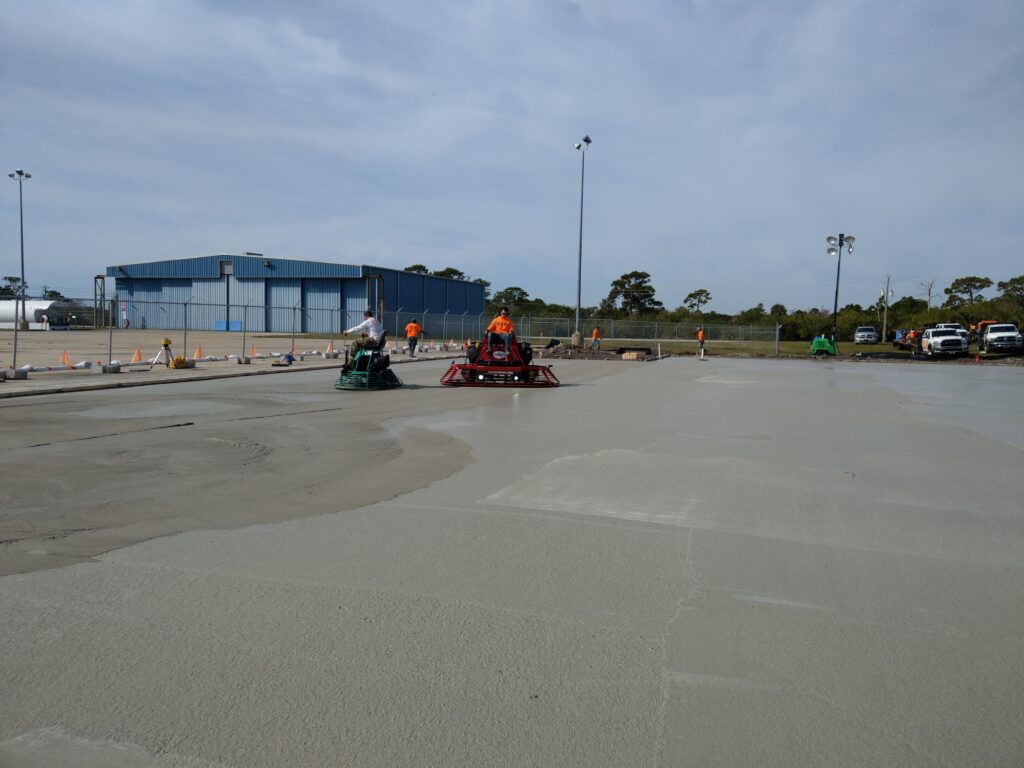
Curing is non-negotiable. Proper curing controls moisture loss, limits shrinkage, and increases long-term strength. Wet cure methods or curing compounds must be applied immediately after finishing. A seven-day curing regimen can be the difference between a slab that remains stable and one that maps with hairline cracks in the first season. Sabal Aviation enforces curing discipline because it protects your investment before the first aircraft rolls in.
Surface profile defines how the space performs. Polished concrete or high-build epoxy systems are more than a look. They resist chemicals, jet fuel, and hydraulic fluids. They clean quickly. They help reflect light, which reduces energy consumption in large bays. The coating system must be compatible with moisture conditions in the slab. Moisture vapor emission testing prevents blistering or delamination. If readings are high, mitigation primers or breathable systems protect the finish and the concrete.
Drainage and slope are operational details with structural consequences. Hangar interiors need intentional slope to trench drains or sumps so wash water and incidental moisture do not pond. Exterior aprons need positive drainage away from the slab and the door line. In Florida, heavy rain and storm surge can overwhelm sites with poor grading. Sabal Aviation designs apron transitions, trench drain capacity, and site grading to move water decisively away from the structure.
Door interfaces are a common failure point. Rolling tracks, embedded rails, and thresholds concentrate loads and collect water. Detailing at these locations must combine thicker concrete, corrosion-resistant embeds, proper sealants, and precise tolerances. A misaligned door that drags on a soft spot will damage both the door and the slab. Precision at the threshold protects both.
Corrosion control runs through the entire package. In coastal Florida, airborne chlorides attack every exposed edge. Quality concrete with low permeability slows the attack. Clear sealers, silane treatments, and careful detailing at exposed edges add another layer of defense. Inside the building, climate control reduces condensation on cold-soaked aircraft and the floor. Less condensation means less water in joints and fewer cycles of wetting and drying that fatigue the slab.
Think beyond the first aircraft. Future fleet changes demand capacity. If you plan to upsize from a turboprop to a large cabin jet, build the slab for the future now. Thickening, reinforcement, and jointing at the outset cost less than structural surgery later. Sabal Aviation designs for the next aircraft, not just the current one. That mindset preserves flexibility and increases resale value.
Inspection and maintenance keep the slab in prime condition. Annual joint sealant checks, early repair of spalls, and fast response to chemical spills extend life. Monitoring settlement near door openings and trench drains catches issues before they become structural. A disciplined maintenance plan keeps the interior operational and the exterior apron safe for tugs and fuel trucks.
Concrete quality is not glamorous. It is decisive. It affects safety, operations, and the owner’s balance sheet. At MLB Melbourne Orlando International Airport, Sabal Aviation elevates the concrete scope to a first-class priority. Owners who treat concrete as the backbone of the project enjoy fewer repairs, better operations, and stronger asset value over time. The right foundation is not just a slab. It is a strategy for longevity.
Explore available custom hangar units at MLB here.